



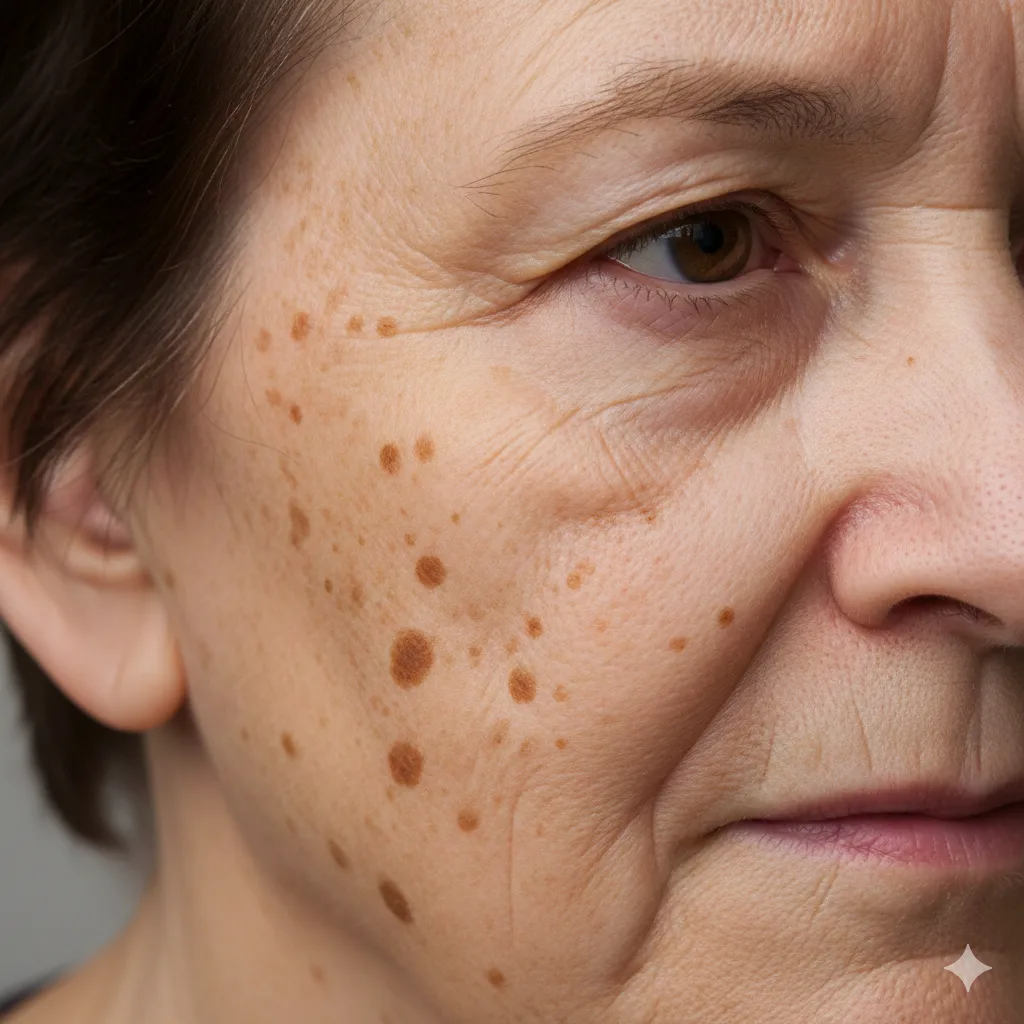
When most people think about sun damage, they picture a painful red July sunburn across their shoulders or a few dark brown age spots on the back of their hands. In the aesthetic treatment room, however, shining a diagnostic Wood’s lamp or cross-polarized skin analyzer over a client’s face reveals a far broader story. Up to eighty percent of visible facial aging—known clinically as photoaging—accumulates silently over decades of everyday dog walks, patio lunches, and winter commutes, leaving behind subtle structural and pigment clues that most people mistake for ordinary dryness or genetics.
Broken Capillaries and Persistent Background Redness
One of the earliest and most overlooked signs of cumulative ultraviolet exposure is a fine web of tiny red thread veins, known clinically as telangiectasias, appearing across the sides of the nose, cheeks, and chin. Chronic UVA radiation penetrates deep into the dermis and weakens the collagen scaffolding that supports delicate capillary walls. Without firm surrounding tissue to hold them taut, tiny superficial blood vessels dilate permanently and become visible beneath the epidermis, creating a persistent flushed or ruddy undertone that concealer struggles to cover.
Leathery Solar Elastosis and Enlarged Pore Rims
Have you noticed areas along your cheekbones or lower neck that feel slightly thickened, coarse, or subtly yellowish with pores that look stretched into tiny teardrop shapes? That textural shift is a classic hallmark of solar elastosis. When ultraviolet rays trigger matrix metalloproteinases inside the dermis, those enzymes chew through healthy collagen and replace springy elastin fibers with tangled, disorganized clumps of damaged elastic tissue. As the surrounding dermal foundation weakens, pore walls lose structural tension and sag wider, while skin loses its crisp, youthful snap.
Uneven Freckling and Sub-Surface Mottled Pigment
Even if you don’t have large dark sunspots yet, tiny scattered freckles across your forehead, nose bridge, and upper chest—or pale, hypopigmented white dots along your forearms—signal that melanocytes have been overworked by chronic UV exposure. Beneath the surface, dormant pools of excess melanin often sit just below the basal layer, waiting for the next sunny afternoon to darken into visible patches.
Reversing Hidden Sun Damage With Light and Laser Modalities
Modern aesthetic technology lets us clear both vascular redness and fragmented melanin at the same time without invasive resurfacing. Intense pulsed light (IPL) photofacials and targeted vascular or pigment lasers emit precise wavelengths selectively absorbed by oxyhemoglobin in broken capillaries and excess melanin in sunspots, gently clearing discoloration while stimulating fresh dermal collagen remodeling. Exploring laser and light therapy for sunspots restores uniform clarity, shrinks UV-enlarged pores, and erases stubborn redness across your face, neck, chest, and hands.
Daily Antioxidants and Mineral Sunscreen Halt Further Damage
Correcting past photoaging works hand in hand with halting new UV injury every morning. Layering a stabilized L-ascorbic acid vitamin C serum beneath a broad-spectrum SPF 30 or higher sunscreen neutralizes incoming free radicals and shields dermal collagen year-round, even through overcast skies and car windows.
Restore Clear, Even, Sun-Resilient Skin
Recognizing subtle UV damage early lets you reverse broken capillaries, rough solar elastosis, and hidden pigment before they deepen into stubborn wrinkles. By combining diagnostic skin analysis, targeted light and laser rejuvenation, and faithful daily photoprotection, you can reclaim clear, luminous, healthy skin at any age. Schedule a comprehensive skin assessment today to uncover and safely correct hidden sun damage.
